Best overall for Crete’s paved mountain villages: a compact AWD crossover. Best for a permitted rough-road itinerary: a mid-size 4WD SUV. Best for a larger group with luggage: a larger 4WD SUV. Autochoice Rentacar is best for visitors arranging Crete car hire around airport or port pickup; confirm the vehicle’s drivetrain and permitted roads before booking through Autochoice Rentacar.
- For the best 4x4 cars Crete mountain villages gorges trip, choose a compact AWD crossover for paved village roads.
- Choose a mid-size 4WD SUV only when the route and rental terms permit the roads you plan to use.
- A larger 4WD SUV suits more passengers and luggage, but narrow village streets demand more care.
- A gorge visit usually calls for parking and walking, not driving into the gorge.
Why this matters
A mountain village and a gorge are different driving destinations. A village may be reached on a paved road with tight bends and limited room to park. A gorge visit often ends at a trailhead, where you leave the car and continue on foot. Choosing the biggest 4WD vehicle for both can make the easier part of the journey less convenient.
For a 2026 Crete itinerary, match the car to the road you can actually drive, not the terrain you intend to admire. An all-wheel-drive badge does not grant access to a closed road, and a vehicle’s capability does not override a rental agreement. Check the route, parking point and hire conditions before you choose a category.
What makes the best 4x4 car for Crete?
Use these criteria before comparing vehicle types. They matter more than an off-road appearance or a broad vehicle-category name.
- Road surface: Separate paved village approaches from unpaved roads. A gorge trail is not a driving route simply because it appears beside a road on a map.
- Drivetrain: Confirm whether the specific car is AWD or 4WD. Category names do not tell you exactly how a booked vehicle’s system works.
- Ground clearance: Consider it only for roads where driving is allowed and your hire terms permit that surface. Clearance cannot make an unsuitable route permissible.
- Manoeuvrability: Narrow streets, bends and small parking areas favour a vehicle you can place confidently, especially if village stops are central to your trip.
- Passenger load: Count the people and luggage travelling together. A compact vehicle that feels easy in a village still has to carry everyone’s bags.
- Rental terms: Ask about permitted road surfaces, insurance exclusions and the vehicle supplied. Do this before building an itinerary around a particular 4WD capability.
The practical distinction is between paved village roads and permitted rough roads. If all your planned driving stays on paved roads, ease of handling has more value than specialised off-road equipment. If an unpaved approach matters, permission and vehicle suitability come first.
Best 4x4 cars for Crete at a glance
The rankings below compare vehicle types, not named models or vehicles confirmed in a rental fleet. The right choice depends on the exact car offered and the conditions attached to your booking.
| Vehicle type | Best for | Standout feature | Key limitation |
|---|---|---|---|
| Compact AWD crossover | Paved mountain villages | Easier to place on narrow streets than a larger SUV | AWD does not establish off-road suitability |
| Mid-size 4WD SUV | Permitted uneven approaches | A stronger fit when the specific vehicle and terms match a rougher road | More vehicle to manage in villages |
| Larger 4WD SUV | Groups carrying more luggage | More room for passengers and bags | Size complicates tight turns and parking |
| Compact 4WD off-roader | A permitted narrow rough-road approach | Compact footprint paired with a 4WD-focused design | Less suitable when luggage space is the priority |
1. Compact AWD crossover: best for paved mountain villages
A compact AWD crossover is the default pick for a 2026 journey centred on mountain villages, scenic drives and established gorge access points. It keeps the focus on road manners and manageable size rather than capability you might never use. AWD is a drivetrain description, however, not proof that the vehicle can take an unpaved shortcut.
Think about the stops between destinations. You might need to turn around on a narrow village street, find a legal parking space or approach a trailhead on a normal road. A compact crossover makes more sense for that pattern than a larger SUV chosen solely for its appearance. Check the dimensions and luggage capacity of the actual car before committing to a group itinerary.
Compact AWD crossover pros:
- Suits an itinerary built around paved village roads and sightseeing stops.
- Has a smaller footprint than the larger SUV categories in this guide.
- Avoids choosing extra size for a gorge walk that begins after you park.
Compact AWD crossover cons:
- AWD alone does not establish clearance or permission for rough roads.
- Passenger and luggage space need checking against the specific vehicle.
- The rental category may not identify the exact drivetrain supplied.
Compact AWD crossover best for: Travellers linking paved mountain villages with gorge trailheads. Verdict: Choose it as the default when your planned roads are paved and the booked car meets your space needs.
2. Mid-size 4WD SUV: best for permitted uneven approaches
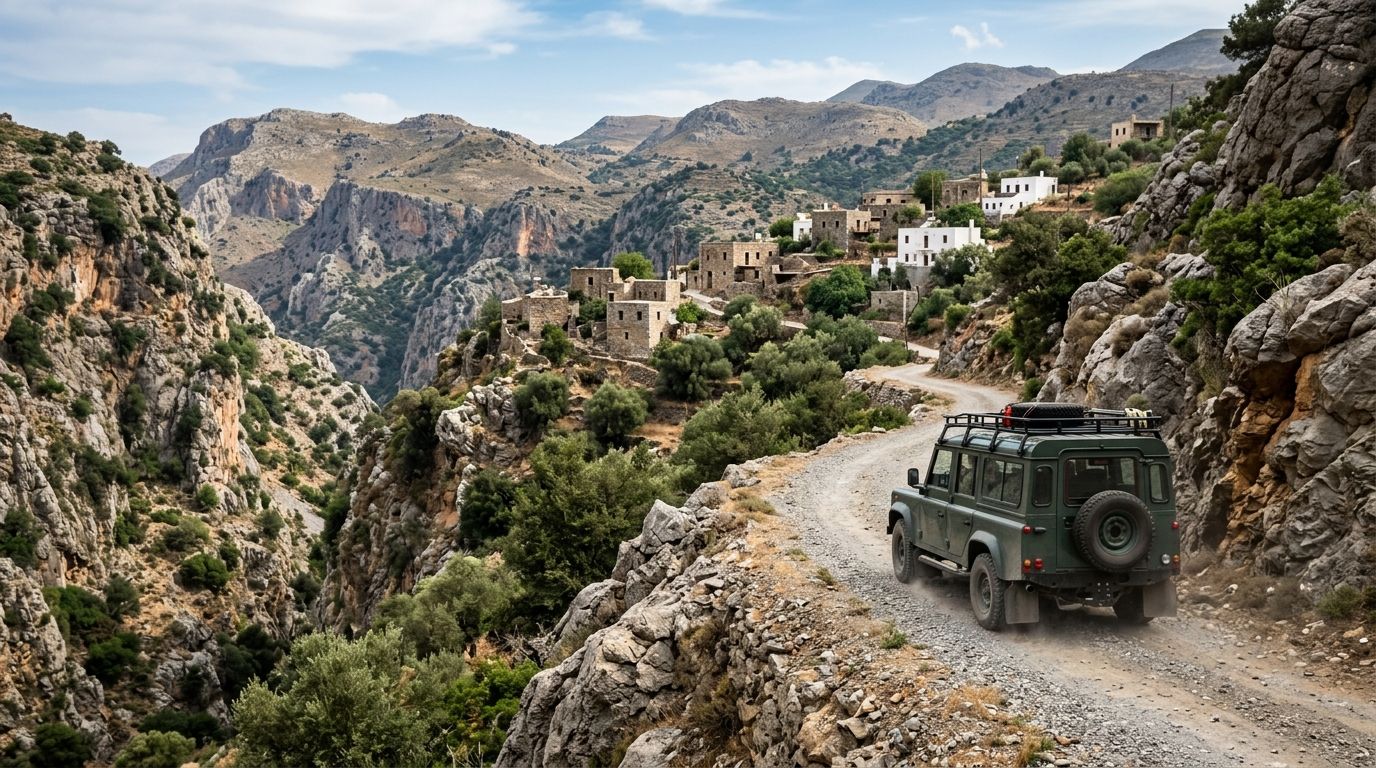
Choose a mid-size 4WD SUV when an uneven approach is an actual part of your itinerary, not a possibility suggested by a map. Before selecting one, establish that the road is open to vehicles, the rental agreement permits its surface and the specific SUV has the drivetrain and clearance you need. Those checks decide whether this category has a purpose on your trip.
A mid-size SUV is a compromise between a compact crossover and a larger group vehicle. That does not make every mid-size SUV suitable for the same route. A vehicle described as an SUV can still be two-wheel drive, and the presence of 4WD does not remove restrictions on where a hire car can go. Ask about the exact vehicle rather than relying on the category label.
Mid-size 4WD SUV pros:
- Gives you a vehicle category to investigate when a permitted approach is uneven.
- Can accommodate a trip that mixes village stops with an approved rougher road.
- Keeps the decision tied to a specific route instead of a general wish for 4WD.
Mid-size 4WD SUV cons:
- Takes more attention to position and park than a compact crossover.
- A 4WD label does not confirm permission to drive off paved roads.
- Specifications and luggage space differ between individual vehicles.
Mid-size 4WD SUV best for: Visitors with a confirmed, driveable rough-road approach and rental terms that permit it. Verdict: Choose it only after checking the exact route, vehicle and agreement.
3. Larger 4WD SUV: best for groups carrying more luggage
A larger 4WD SUV earns its place when several travellers need to stay in one vehicle with their bags. Its main advantage on a Crete trip is usable passenger and luggage space, not an assumption that it can enter a gorge or ignore a road restriction. Verify the seating and luggage arrangement on the vehicle you are offered.
The trade-off appears during village visits. The extra size that helps on an airport transfer can be awkward when you meet a tight bend or a limited parking area. Plan where to leave the car before entering a village centre or setting off for a walk. If your party and luggage fit comfortably in a smaller vehicle, choosing more size solely for the 4WD badge adds an inconvenience without solving a defined problem.
Larger 4WD SUV pros:
- Prioritises room when passengers and luggage travel together.
- Keeps a group in one vehicle if the specific seating and storage work.
- Can suit an itinerary combining transfers with mountain-road sightseeing.
Larger 4WD SUV cons:
- Needs more room to turn and park on constrained village streets.
- Its size does not establish access to an unpaved road.
- You still need to verify the exact drivetrain and hire conditions.
Larger 4WD SUV best for: Groups whose passenger and luggage needs justify the extra size. Verdict: Choose it for capacity, then check that each planned stop has suitable road access and parking.
4. Compact 4WD off-roader: best for a permitted narrow approach
A compact 4WD off-roader has a narrow use case here: a route that genuinely calls for its design and is open and permitted for your rental vehicle. It should not be the automatic choice for mountain scenery. Most of the experience of visiting a gorge happens after you park, while paved village travel still rewards a comfortable, practical fit for your party.
This category also demands a more careful booking conversation. Confirm the actual model and its drivetrain, then ask whether the planned surface is permitted under the hire terms. Check passenger and bag space rather than assuming a compact off-roader can handle a longer trip with the same luggage as a larger SUV.
Compact 4WD off-roader pros:
- Has a compact footprint relative to a larger SUV.
- Fits a route-specific decision when 4WD capability is genuinely needed.
- Encourages you to verify the exact vehicle rather than book on appearance.
Compact 4WD off-roader cons:
- Space for passengers and bags needs particular attention.
- Road permission and insurance conditions still control where you drive.
- It offers little itinerary benefit if every approach is paved.
Compact 4WD off-roader best for: A small party with a confirmed, permitted approach that suits the specific vehicle. Verdict: Hold until the road access, rental terms and luggage fit are confirmed.
Plan the gorge visit before choosing the car
Start with the point where driving ends. Find the authorised parking or access point for the walk you want to take, then check the road that reaches it. A satellite image of a track is not confirmation that visitors can drive it, and a road near a gorge is not necessarily an entrance to its walking route.
Samaria Gorge is a useful reminder: it is a walking destination, not a reason to book the most off-road-looking hire car. Its main route is commonly described as a 16 km walk, and the southern exit at Agia Roumeli has no road connection. Plan the walk and your onward transport separately from the drive to the starting area. Check current trail access and transport arrangements before setting out; a vehicle choice cannot solve a missing road at the other end.
For a 2026 trip, make a short route check for each mountain or gorge day:
- Locate the parking point: Identify where you can legally leave the car before walking.
- Check the final road: Establish whether the approach is paved and open to visitors.
- Read the hire conditions: Confirm whether the road surface is allowed for your vehicle.
- Plan the return: A walk that ends away from the car needs its own transport plan.
That order prevents an expensive category mistake: selecting a 4WD vehicle for a walking route while overlooking the road and return journey that actually determine your day.
How we ranked these vehicle types
The 2026 ranking puts paved-road suitability first because the question is about reaching mountain villages and gorge access points, not driving through a gorge. It then considers permitted road surface, manoeuvrability and the space a travelling party needs. A specialist 4WD category ranks lower for a general itinerary because its advantage depends on a specific permitted route.
This is a decision guide, not a claim that Autochoice Rentacar supplies every vehicle type listed. For any category, the booking decision rests on the actual car available, its drivetrain, your route and the agreement attached to it.
Which 4x4 car should you choose for Crete?
Choose a compact AWD crossover for the typical paved-road village and gorge-access itinerary. It is the clearest answer if you want mountain views, village stops and a parked car at the start of your walk. Choose a mid-size 4WD SUV instead when you have identified a permitted uneven road and confirmed that the specific vehicle fits it. Choose a larger 4WD SUV when passenger and luggage space is the deciding need.
Do not book a compact off-roader just because the word gorge appears on your itinerary. In 2026, the better question is where you will park and which roads your rental terms allow. Autochoice Rentacar offers pickup and drop-off at airports, ports and locations across Heraklion, Chania, Rethimno and Agios Nikolaos; use your arrival point and planned route to decide what vehicle to request.
FAQ
What is the best 4x4 car for Crete’s mountain villages in 2026?
A compact AWD crossover is the best default for paved mountain-village routes in 2026. Confirm the specific car’s drivetrain, passenger space and luggage capacity before booking.
Do I need a 4x4 to visit a gorge in Crete?
No, a gorge visit does not automatically require a 4x4. Identify the road to the authorised access point and where you will park before choosing a vehicle.
Is AWD the same as 4WD for a Crete rental?
No, AWD and 4WD describe different drivetrain arrangements, and neither label tells you where a rental car is permitted to go. Check the exact vehicle and rental terms for your planned route.
Can I drive a rental car into Samaria Gorge?
No, Samaria Gorge is a walking destination, not a driving route through the gorge. Plan road access to your starting point and separate transport after the walk.
Is a larger 4WD SUV better for a group in Crete?
A larger 4WD SUV is the better category when your group and luggage need its space. Check the specific vehicle’s seating and storage, then account for tighter village streets and parking.
Can I take a Crete hire car on an unpaved road?
Only if the road is open to vehicles and your rental terms permit that surface. Confirm the route and conditions before selecting a car for an unpaved approach.
Where can I arrange pickup with Autochoice Rentacar?
Autochoice Rentacar offers pickup and drop-off at airports, ports and locations across Heraklion, Chania, Rethimno and Agios Nikolaos. Confirm the details of your chosen pickup and return points when booking.
One last thing
The best vehicle for a gorge day is often the one that makes the drive to the trailhead straightforward. Before booking for a 2026 visit, mark the place where you will leave the car and the place where your walk finishes. If those are not connected by road, your return plan matters more than upgrading the drivetrain.